
A pinched nerve in the neck rarely feels like a neck problem. People describe a burning ache across the shoulder blade, an electric zap down the arm, or two fingers that have gone numb and won’t wake up. The neck itself may only feel stiff, or not hurt at all.
The good news comes first, because it’s what most people want to know: the large majority of pinched nerves in the neck get much better without surgery, usually over weeks to a few months. Below is what’s going on, how to tell which nerve is involved, how long recovery tends to take, and when to have it checked. For the bigger picture on neck care, see our page on neck pain treatment.
What “pinched” actually means
Eight pairs of nerves leave the neck and run down into the shoulders, arms, and hands. Each one exits through a small opening between two vertebrae. When something crowds that opening, the nerve gets irritated. Doctors call this cervical radiculopathy.
In people under about 50, the usual cause is a herniated disc pushing onto the nerve. In older adults it’s more often a slow narrowing of the opening from arthritis and bone spurs. A sudden injury, such as whiplash in a car accident, can set off either one.
Your fingers can point to the nerve
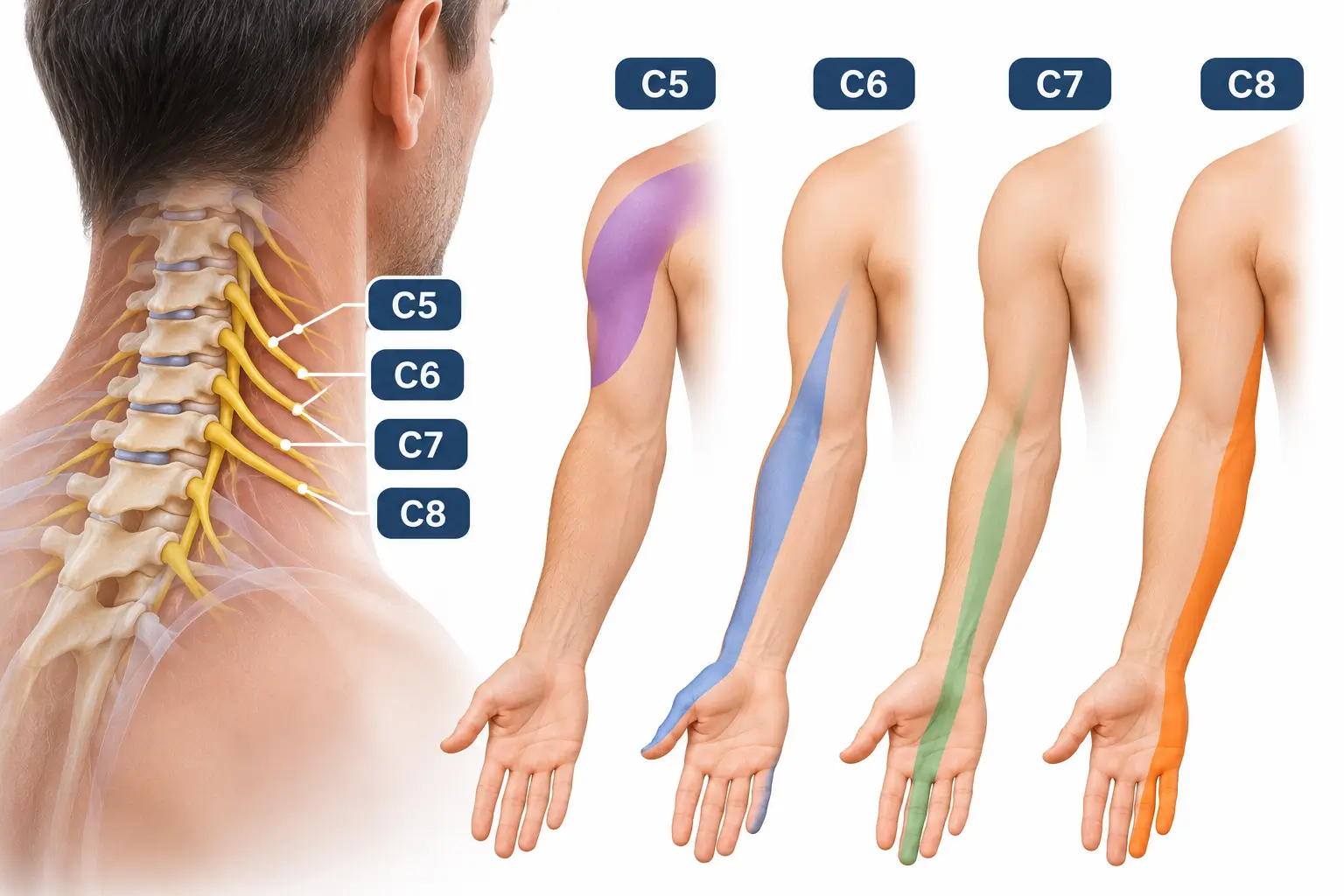
Each nerve supplies its own strip of skin and its own muscles, so where the numbness lands is a useful clue. The C7 nerve is the one most often involved, followed by C6.
| Nerve | Where numbness or tingling usually shows up | Weakness you might notice |
|---|---|---|
| C5 | Outer shoulder and upper arm | Lifting the arm out to the side |
| C6 | Thumb and index finger | Bending the elbow, cocking the wrist back |
| C7 | Middle finger | Straightening the elbow, pushing open a heavy door |
| C8 | Ring and little fingers | Grip and fine finger movements |
There’s overlap between them, so this is a pointer for your physician, not a self-diagnosis.
Signs it’s coming from the neck, not the wrist or shoulder
Numb fingers send a lot of people to look up carpal tunnel syndrome, and a sore shoulder blade sends others to a shoulder specialist. A few clues suggest the neck is the real source:
- Turning or tilting your head changes the arm symptoms. Looking up, or tilting toward the painful side, often sharpens them.
- Resting your hand on top of your head brings relief. Many people discover this on their own. Lifting the arm takes tension off the nerve, which is why it helps.
- The pain runs past the elbow and follows a line down the arm, rather than staying around the shoulder joint.
- Pain sits along the inner edge of the shoulder blade. Neck nerves commonly refer pain there.
Carpal tunnel, by contrast, usually affects the thumb, index, and middle fingers together, is often worse at night, and doesn’t change when you move your neck.
How long does it last?
For most people, the worst of the arm pain eases within a few weeks, and the large majority improve substantially within four to six months. In a long-term study of people with this condition in Rochester, Minnesota, nearly 90 percent were symptom-free or had only mild symptoms when checked about four years later.
As with a pinched nerve in the lower back, the order of recovery matters. Pain usually settles first. Numbness and tingling linger longer, sometimes for months, because irritated nerves recover slowly. Weakness, if there was any, usually comes back gradually as well. Our guide to herniated disc healing time explains why the nerve tends to calm down long before the disc looks any different on a scan.
What helps in the meantime
Gentle movement beats rest. Keep using the arm normally, take short walks, and avoid holding your head in one position for long stretches, such as looking down at a phone or leaning toward a screen. Many people find a pillow that keeps the neck level, neither propped up nor dropped, makes nights easier.
Physical therapy helps once the sharpest pain has eased, with exercises that strengthen the deep neck and upper back muscles and improve posture. Short courses of medication can take the edge off. A soft collar can feel good for a day or two, but wearing one for long tends to weaken the muscles that support the neck.
When arm pain stays severe despite all that, a cervical epidural steroid injection can calm the inflamed nerve, often enough to get through physical therapy and sleep properly. Our epidural injection recovery guide covers what the days afterward look like. Surgery is reserved for weakness that’s getting worse or pain that hasn’t responded to good nonsurgical care over several months.
When not to wait
A pinched nerve affects one arm. Pressure on the spinal cord itself is a different and more serious problem. Get seen promptly if you notice symptoms in both arms, hands that feel clumsy (dropping things, trouble with buttons or handwriting), changes in your balance or walking, or weakness that’s getting worse. Go to an emergency department for loss of bladder or bowel control, or for sudden severe neck pain after a fall or accident.
After a car accident, it’s worth being checked even if you feel fine, since neck symptoms often appear a day or two later. Our guide to back and neck pain after a car accident in New Jersey also explains how PIP covers your care.
Getting it checked
Consider an evaluation if arm pain or numbness has lasted more than a few weeks, keeps coming back, or is keeping you from sleeping or working. A pain specialist can pin down which nerve is involved, decide whether imaging will actually change the plan, and build a treatment plan around getting you back to normal. If it’s your first visit, here’s what to expect at your first appointment.
ReclaimAbility Pain Services treats neck pain and pinched nerves at our Mount Laurel, Haddonfield, Washington Township, and Linwood offices. Request an appointment or call 855-727-2465.
Sources
- Iyer S, Kim HJ. Cervical radiculopathy. Current Reviews in Musculoskeletal Medicine, 2016. PMC
- Radhakrishnan K, et al. Epidemiology of cervical radiculopathy: a population-based study from Rochester, Minnesota, 1976 through 1990. Brain, 1994. PubMed
This article is for general education and is not a substitute for a medical evaluation. If you have new or worsening symptoms, talk with a qualified clinician.