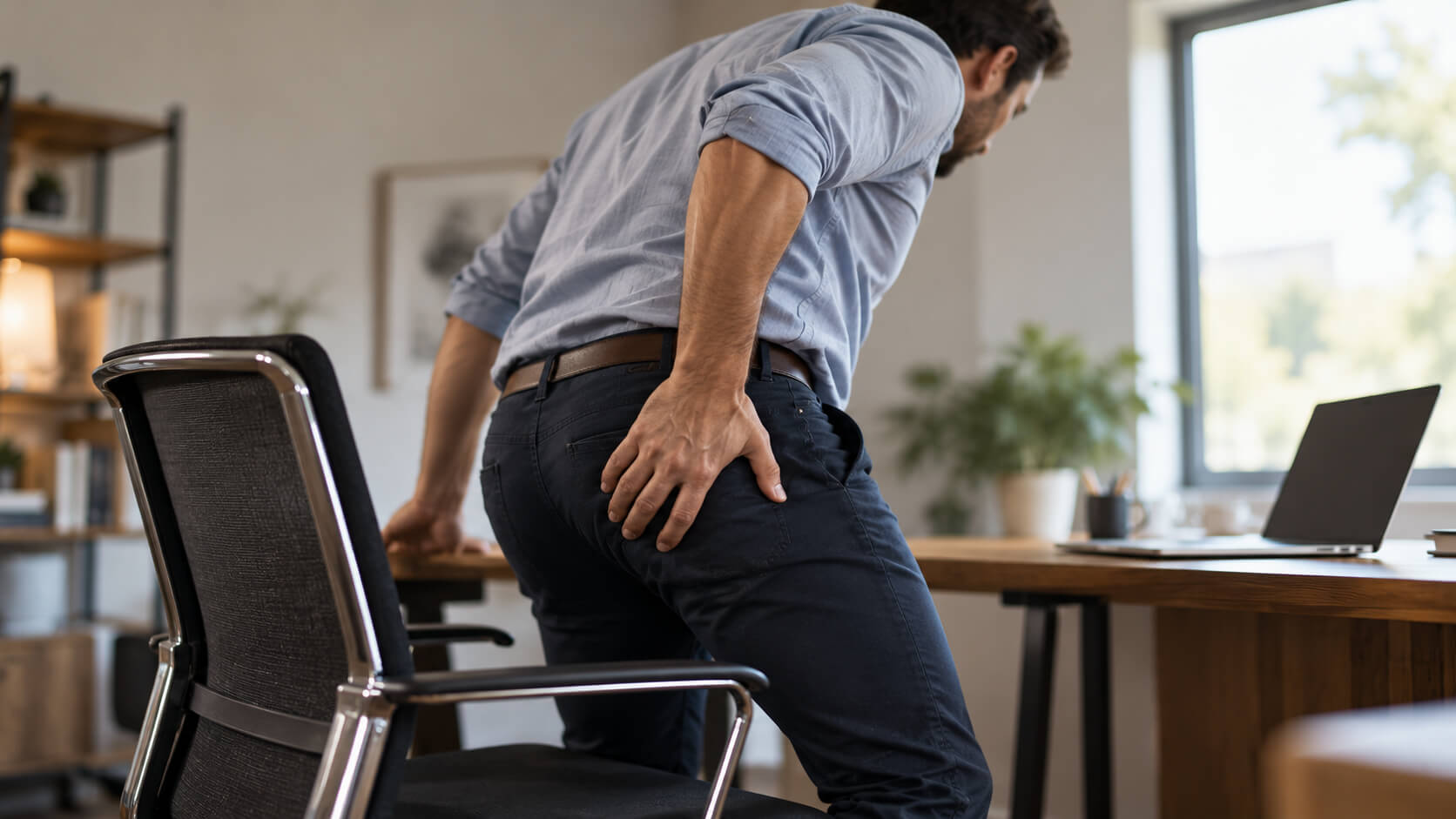
If you’ve just been told you have a herniated disc, the first question is usually how long this is going to last. The honest answer is better than most people expect. The majority of people with a herniated disc in the lower back feel much better within six to twelve weeks, and most never need surgery.
There’s a catch worth understanding, though. Feeling better and the disc looking different on a scan happen on two separate clocks, and knowing the difference saves a lot of worry. If you want the bigger picture on how we treat the lower back, see our page on low back pain and sciatica treatment. For the basics of the condition itself, start with our disc herniation page.
What “healing” actually means
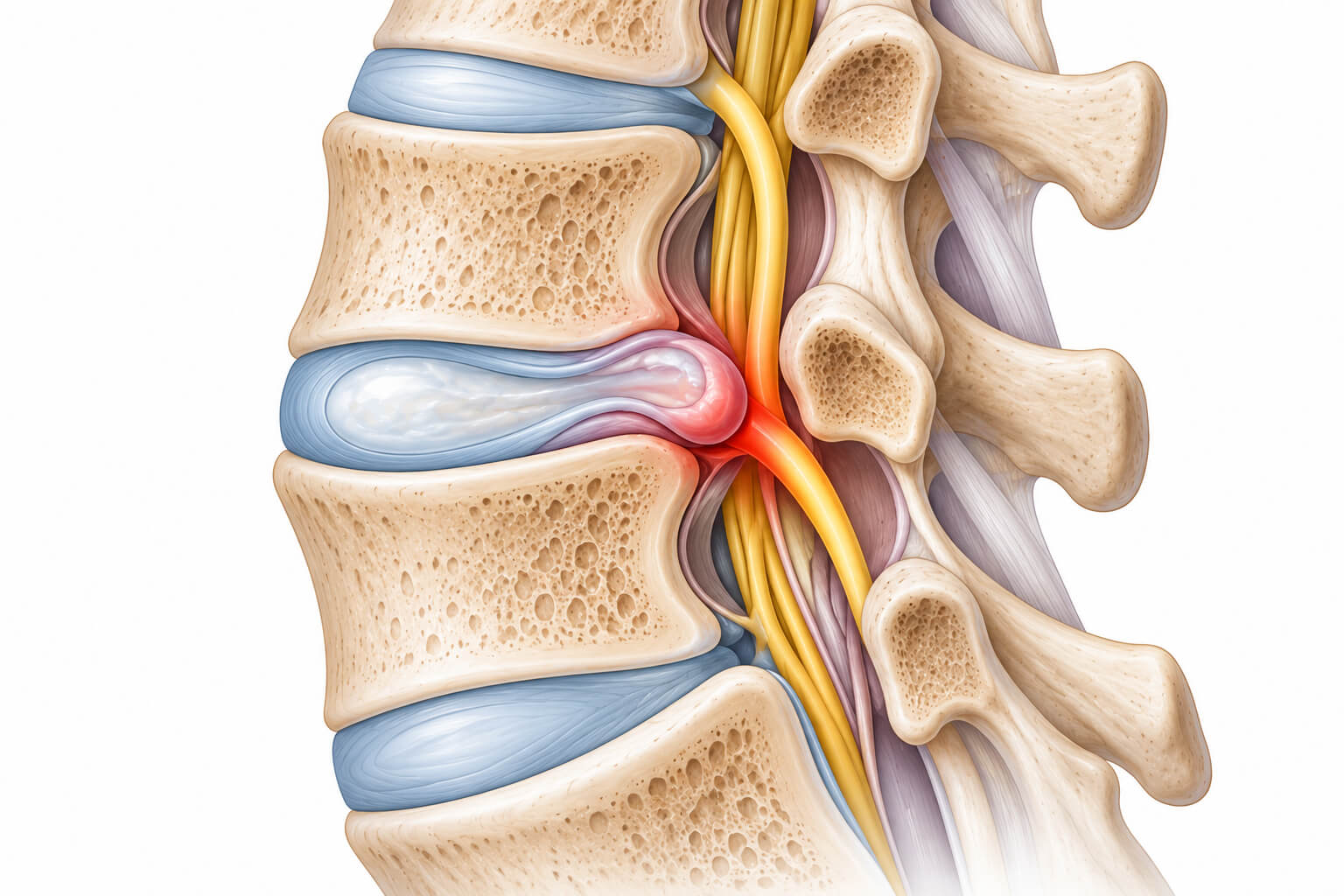
A herniated disc hurts for two reasons, not one. Part of the soft center of the disc pushes out and can press on a nerve root. But that material is also chemically irritating, and the inflammation it sets off around the nerve causes much of the burning, shooting leg pain people describe.
Inflammation is the fast part. It usually starts settling within the first few weeks. The slow part is the disc material itself, which the body can gradually break down and reabsorb over months. That’s why many people feel dramatically better long before their disc would look any different on an MRI, and why a follow-up scan is rarely needed when symptoms are steadily improving.
A realistic timeline
Every disc is different, but recovery tends to follow a recognizable pattern.
| Time since symptoms began | What usually happens | What helps most |
|---|---|---|
| First 2 weeks | Pain is at its worst. Sitting, bending, and coughing often make the leg pain spike. | Short walks, changing position often, short-term medication |
| 2 to 6 weeks | Pain eases in fits and starts. Good days and bad days are normal. | Gradually more activity, starting physical therapy |
| 6 to 12 weeks | Most people are clearly better. Leftover numbness or tingling is common. | Strengthening work; an evaluation if progress has stalled |
| 3 to 12 months | The disc material may continue shrinking. Lingering nerve symptoms keep fading. | Staying active and keeping up the exercises |
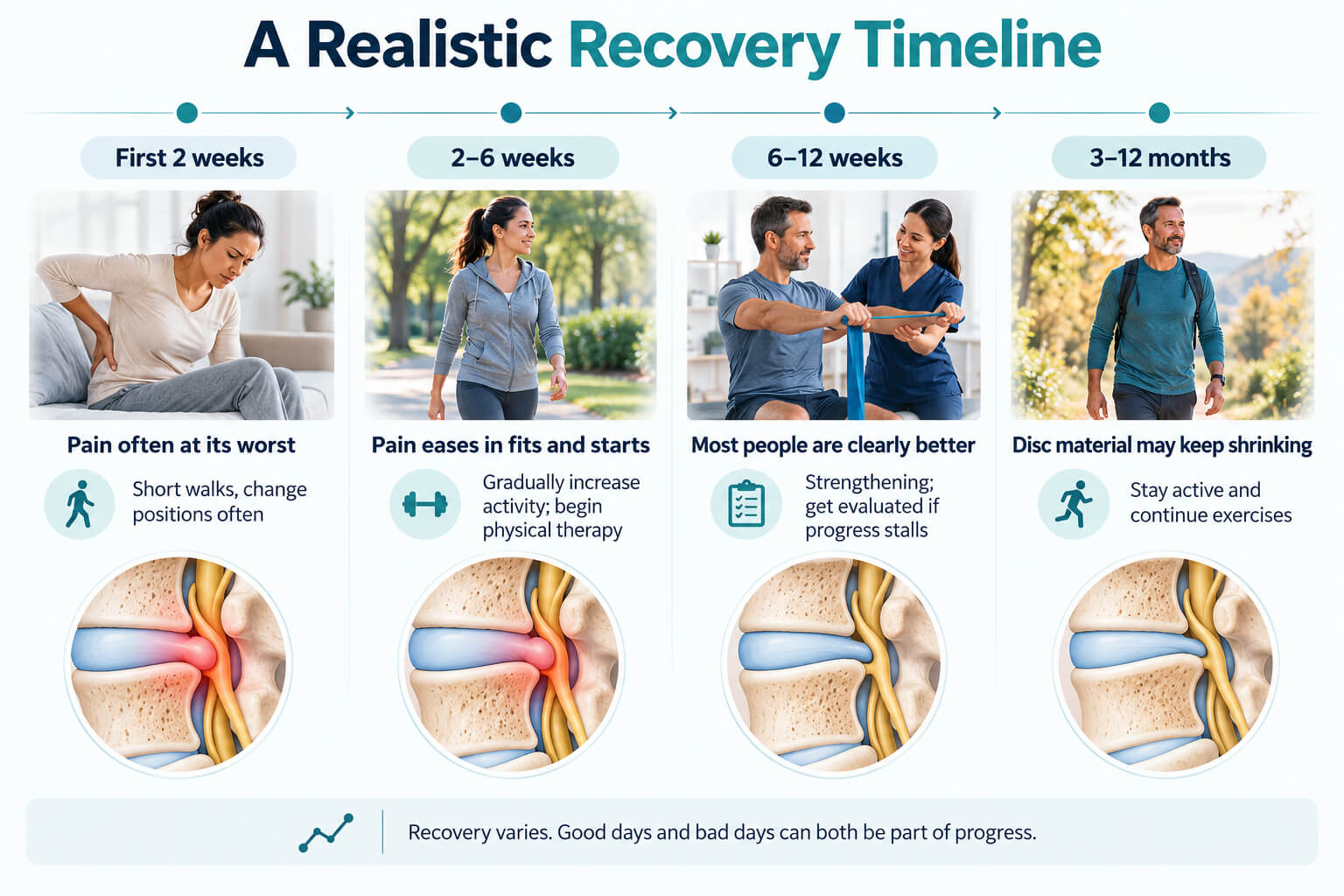
Recovery rarely moves in a straight line. A rough day in week four doesn’t mean you’ve gone backward, especially after a long car ride or a day of yard work.
The surprising part: bigger herniations often shrink more
It sounds backward, but larger herniations are often the ones most likely to shrink on their own. A 2015 systematic review in Clinical Rehabilitation found that about 13 percent of bulging discs regressed, compared with roughly 41 percent of protrusions, 70 percent of extrusions, and 96 percent of sequestrations, where a fragment has broken free entirely. The likely reason is that disc material sitting farther out is more exposed to the immune cells that clear it away.
That doesn’t mean a large herniation hurts less or is less serious. Size on a scan and severity of symptoms don’t line up neatly. But if you’ve been told your herniation is “large,” it isn’t automatically a reason to think surgery is inevitable.
Signs your disc is healing
The clearest sign is often one patients misread. As a disc settles, leg pain tends to retreat back toward the spine. Pain that used to reach your foot now stops at the knee, then at the buttock. It can feel like the pain is “moving into your back,” which sounds worse but is actually a good sign.
Other encouraging changes include sitting longer before the pain builds, sleeping through more of the night, and needing less medication. Numbness and tingling are usually the last symptoms to go. They can linger for weeks or months after the pain has eased, because irritated nerves recover slowly.
If your pain sits mostly deep in one buttock and gets worse with sitting, it’s worth knowing that not every case of “sciatica” is a disc. Our article on sciatica vs. piriformis syndrome explains how to tell.
Signs it isn’t, and what to do
Book an evaluation if there’s been no real improvement by about six weeks, if the pain is keeping you from working or sleeping, or if you’ve improved and then slid back. Leg weakness that is getting worse, such as a foot that slaps the ground or trouble standing on your toes, needs to be seen promptly.
A few symptoms need an emergency department, not an appointment: loss of bladder or bowel control, numbness in the groin or inner thighs, or weakness in both legs. These are rare, but they’re the reason it’s worth knowing the list.
What actually speeds recovery
Movement helps more than rest. Bed rest used to be standard advice, but it doesn’t speed recovery, and staying gently active with short walks several times a day helps most people return to normal sooner. Breaking up long stretches of sitting helps too, since that’s when leg pain from a disc tends to build.
Physical therapy matters most once the worst of the pain has eased. A good program builds the muscles that support the spine and teaches you which movements calm your symptoms rather than stir them up.
When leg pain stalls despite all of that, an epidural steroid injection is often the next step. It doesn’t repair the disc. What it does is calm the inflamed nerve so you can move, sleep, and do your exercises while the body finishes its work. Our guide to epidural injection recovery covers what that looks like day by day.
When surgery makes sense
For most people, surgery is a question of speed rather than outcome. A large Dutch trial published in the New England Journal of Medicine followed 283 people with severe sciatica from a herniated disc. Those who had early surgery recovered faster, but those who started with nonsurgical care caught up, and results were similar at one year.
That leaves a smaller group for whom surgery is clearly the right call: worsening weakness, the emergency symptoms above, or severe pain that hasn’t responded to good nonsurgical care over several months. Your physician will tell you plainly which group you’re in.
Getting it checked
Most new back and leg pain settles without a specialist, and our guide on how long back pain should last lays out a reasonable timeline. If you’re past the six-week mark or simply want a clear plan, here’s what to expect at your first appointment.
ReclaimAbility Pain Services treats herniated discs at offices in Mount Laurel, Haddonfield, Washington Township, and Linwood. Request an appointment or call 855-727-2465.
Sources
- Chiu CC, et al. The probability of spontaneous regression of lumbar herniated disc: a systematic review. Clinical Rehabilitation, 2015. PubMed
- Peul WC, et al. Surgery versus prolonged conservative treatment for sciatica. New England Journal of Medicine, 2007.
This article is for general education and is not a substitute for a medical evaluation. If you have new or worsening symptoms, talk with a qualified clinician.