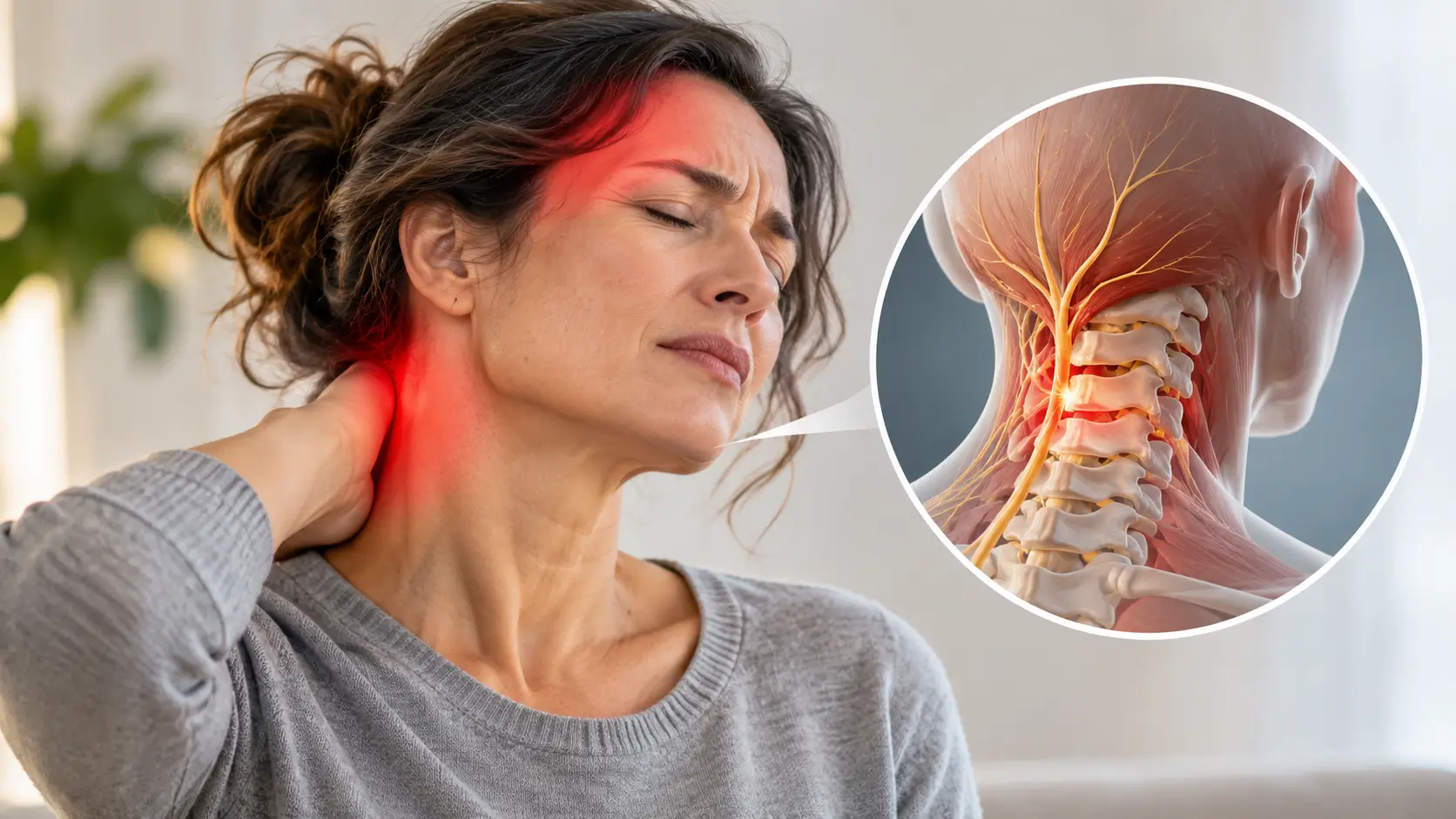
Most of the time, pain between the shoulder blades comes from the upper back and neck themselves: an overworked muscle, a cranky joint in the mid spine, or a pinched nerve in the lower neck. These usually settle down with time and the right care.
That hard-to-reach spot can also pick up pain from elsewhere. The heart, the gallbladder and the aorta can all refer pain there, so it’s worth knowing which signs point away from the back. For more on how we evaluate and treat this part of the spine, see our page on mid back and upper back pain.
What usually causes pain between the shoulder blades?
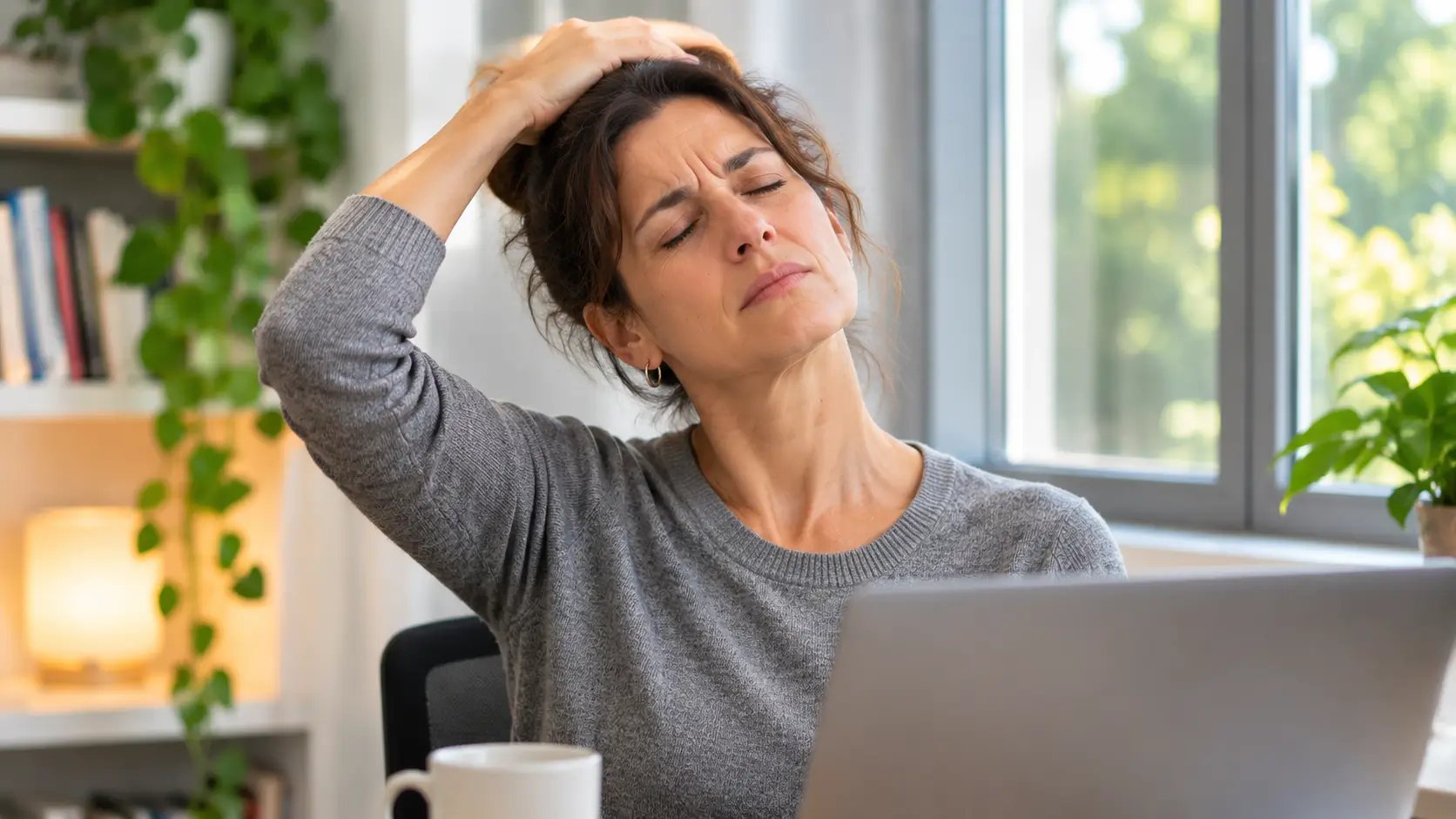
Muscle strain is the usual culprit. The rhomboids and middle trapezius run between your shoulder blades and hold them steady all day. A long stretch at a laptop with your shoulders rounded forward will tire them out. So will a long drive or the first week back at the gym.
Muscle pain usually feels like a dull ache or a burn that gets worse as the day goes on. Press around and you can often find the exact spot. Some people end up with tight knots, called trigger points, that send an ache into a wider patch of the back. When that pattern hangs on for weeks rather than days, we call it myofascial pain.
Can a problem in your neck cause it?
Yes, and it’s one of the causes people least expect. A bulging disc or arthritic narrowing in the lower neck can press on a nerve root as it exits the spine. You don’t always feel that in your neck. Often it shows up along the inner edge of the shoulder blade instead.

In a study of patients who had surgery to free one compressed nerve root in the neck, the pain in and between their shoulder blades came directly from that root, and where it sat helped surgeons tell which root was involved. A 2025 review adds that this shoulder blade pain can show up weeks before any pain in the arm.
So if the ache gets worse when you look up at a high shelf or turn your head to back out of a parking spot, or if you notice tingling down the arm or a weaker grip, the neck becomes the prime suspect. Doctors call that cervical radiculopathy, and a herniated disc is a frequent cause. See our guide to a pinched nerve in the neck for how long it lasts.

Could it be coming from the mid back itself?
Each vertebra in the mid back has small joints on either side, and each rib has its own joint where it meets the spine. When one of these gets irritated, the pain tends to be sharper and sits just off to one side of the spine. Twisting to grab something from the back seat, reaching overhead or taking a deep breath can set it off. Wear and tear in these joints is covered on our page on spondylosis and facet syndrome.
Burning or zapping pain that wraps around the side of your chest along a rib is a different story: usually an irritated nerve between the ribs, called intercostal neuralgia.
When is it not a back problem at all?
Organs in the chest and upper belly share nerve pathways with the upper back, so their pain can land here.
The heart is the one to take seriously first. The American Heart Association notes that some women having a heart attack describe upper back pressure, a squeezing feeling or the sense of a rope being tied around them. Back pain that comes on with exertion, or arrives with shortness of breath, sweating or nausea, is not something to sleep on.
The gallbladder is another. When a gallstone blocks a duct, the pain can start under the right ribs and spread to the back between the shoulder blades or to the right shoulder. These attacks can last anywhere from several minutes to a few hours.
Less often, the pain comes from a tear in the wall of the aorta, which causes sudden, severe chest or upper back pain that people describe as tearing. Pain that catches with every breath, especially with a cough or fever, may come from the lining of the lungs.
A rule of thumb: if pressing on your back or moving your neck doesn’t change the pain, and other symptoms come with it, get it checked as a medical problem first.
When should you seek emergency care?
Call 911 or go to the nearest emergency room if pain between your shoulder blades comes with any of these:
- Chest pressure or pain, shortness of breath, cold sweat, nausea or lightheadedness
- Sudden, severe or tearing pain in the chest or back
- Severe upper abdominal pain that keeps you from sitting still, yellowing of the skin or eyes, or a high fever with chills
- New weakness or numbness in the arms or legs, trouble walking, or changes in bladder or bowel control
- Pain after a fall or car accident, or pain with fever, unexplained weight loss or a history of cancer
How is it diagnosed and treated?
A good evaluation starts with questions and hands. We’ll ask what sets the pain off, then press along the muscles and joints, move your neck and shoulders, and check strength, reflexes and feeling in your arms. An MRI is ordered when the exam points to a nerve or disc, not by default.
Most muscle and joint pain gets better with a few weeks of physical therapy, heat, a better desk setup and, when it’s safe for you, a short course of medication. If it keeps coming back, treatment depends on where it’s coming from. A trigger point injection can release a stubborn muscle knot. A medial branch block tests whether a spinal joint is the source, and if it is, radiofrequency ablation can give longer relief. When a pinched nerve in the neck is behind it, an epidural steroid injection may help calm the nerve down.
Book a visit if the pain has lasted more than a few weeks, keeps returning, wakes you up at night, or comes with arm symptoms.
Getting it checked
Our physicians see patients with upper and mid back pain at four South Jersey offices: Mount Laurel, Haddonfield, Linwood and Washington Township. Not sure what happens at a first visit? Here’s what to expect at your first pain management appointment. You can request an appointment online or call 855-727-2465, Monday to Friday, 8:00 a.m. to 4:30 p.m.
Sources
- Tanaka Y, Kokubun S, Sato T, Ozawa H. Cervical roots as origin of pain in the neck or scapular regions. Spine. 2006;31(17):E568-E573. PubMed
- Scapular pain in cervical radiculopathy: a scoping review. North American Spine Society Journal. 2025;23:100619. PMC
- American Heart Association. Heart attack symptoms in women. heart.org
- Mayo Clinic. Gallstones: symptoms and causes. mayoclinic.org
This article is for general education and is not a substitute for a medical evaluation. If you have new or worsening symptoms, talk with a qualified clinician.