
Yes, neck pain can cause headaches. When the trouble is in a joint, nerve or ligament near the top of the spine, the headache is called cervicogenic, which just means it starts in the neck. It usually begins at the back of the head on one side and creeps forward toward the temple or eye. Turning your head, or holding it in one position for too long, tends to make it worse.
These headaches get mistaken for migraine or tension headaches all the time. That’s a problem, because migraine medicine often does little for a headache that is really coming from the neck. Telling them apart is usually the first job when someone comes to see us about neck pain and what’s behind it.
How can a neck problem cause a headache?
It comes down to wiring. The nerves from the top of your neck and the main sensory nerve of your face, the trigeminal nerve, report to the same small area in the brainstem. When signals arrive there on a shared line, the brain can’t always tell which one they came from. So pain from a joint in your upper neck can feel like it’s in your forehead or behind your eye.
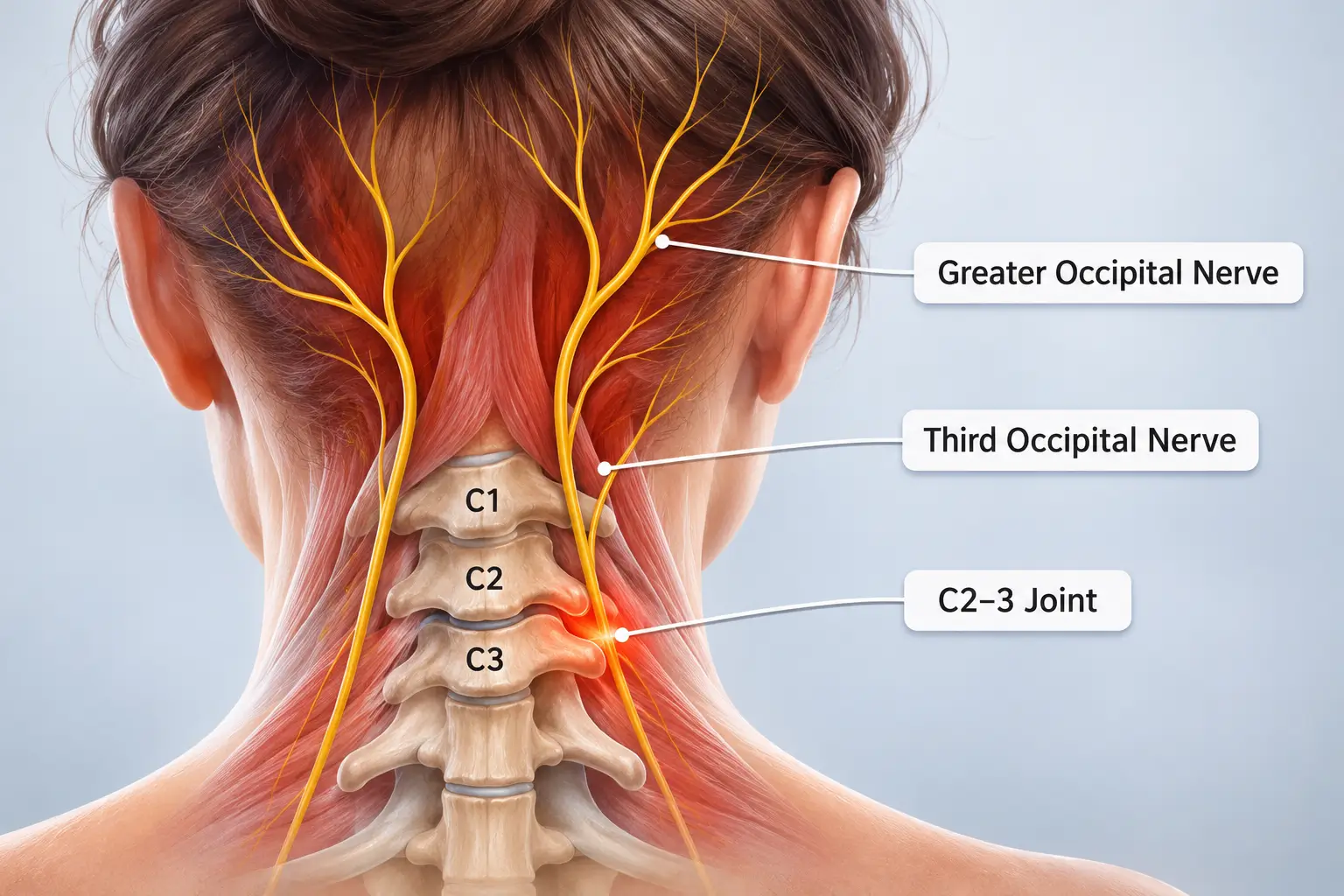
The usual culprits are the small joints at the top of the spine, the discs and ligaments around them, and the nerves leaving that part of the neck. One of those nerves, the greater occipital nerve, runs up the back of the scalp. When it’s irritated, the result is a related condition called occipital neuralgia, which tends to feel sharper, more like zapping or shooting pain.
What does a headache from the neck feel like?
The International Headache Society describes a few features that point toward the neck. None of them proves it on its own, but together they’re a strong hint:
- The pain is on the same side every time.
- It starts at the back of the head or top of the neck and works its way forward.
- Pressing on certain spots in your neck sets off your usual headache.
- Head movement, or a long stretch in one posture, makes it worse.
- Your neck doesn’t turn as far as it used to.
Nausea or light sensitivity can happen, but it’s usually milder than with migraine. Migraine is more likely to throb, switch sides, and come in distinct attacks. A tension headache feels more like a tight band around both sides of the head. Plenty of people have two types at once. Our page on headaches goes through the other types.
Before an appointment, notice when the headaches show up. After a long drive? Late in a day at the laptop? First thing in the morning after sleeping on your stomach? Patterns like that are real clues.
What causes it?
Whiplash is one of the most studied causes. In a study of 100 people who still had neck pain long after a whiplash injury, about 27 percent had headaches traced to one joint at the top of the neck, the C2-3 joint. In those whose headache was the main complaint, the figure was about 53 percent.
Other causes include wear in the upper neck joints, old neck injuries and, less often, inflammatory arthritis, infection or a tumor. Hours spent looking down at a phone or screen don’t cause the condition by themselves, but they can keep an irritated neck from settling.
If the pain runs down into your arm, with numbness or tingling in your fingers, that points to a nerve root lower in the neck. Our guide to a pinched nerve in the neck covers that pattern.
How is it diagnosed?
No scan settles it. Many people who never get headaches show wear in the upper spine on an X-ray or MRI, so imaging mainly rules out other problems.
Instead, we start by listening: where the pain begins, what sets it off, what eases it. The exam checks how far your neck turns and whether pressing on particular joints brings on your familiar headache. Even so, in the whiplash study above, history and examination alone couldn’t reliably pick out who had a joint problem. What did was a diagnostic nerve block.
A medial branch block numbs the tiny nerves that carry pain from a single joint. You then keep track of your headache over the next few hours. If it fades while the numbing medicine is working, that joint is very likely the source. An occipital nerve block at the back of the scalp does the same job when occipital neuralgia is the suspect. Here’s what to expect at your first appointment.
What treatment helps?
Physical therapy usually comes first, and there’s decent evidence behind it. In a trial of 200 people with cervicogenic headache, six weeks of either hands-on manual therapy or a specific, gentle neck exercise program cut how often and how badly headaches hit. The improvement was still there a year later. Doing both wasn’t clearly better than either alone.
When therapy hasn’t done enough, the same blocks used to find the source can also treat it. An occipital nerve block can calm an irritated occipital nerve for a while. If a medial branch block points to a specific joint, radiofrequency ablation can turn down the pain signals from that joint for longer.
Be careful with over-the-counter painkillers. Taking them on many days of the month can cause rebound headaches, which keep the whole cycle going. If you find yourself reaching for them most days, that’s reason enough to get checked.
When should you get urgent care?
Most headaches from the neck aren’t dangerous. Some headaches are, though. Go to an emergency department or call 911 for:
- A sudden, severe headache that peaks within a minute
- Sudden neck pain and headache after a neck injury, a fall or neck manipulation
- Headache with fever and a stiff neck
- Weakness, numbness, slurred speech, confusion, loss of balance or vision changes
- A headache that began after a head injury
Book a prompt visit with a doctor if your headaches are new after age 50, keep getting worse, have changed their usual pattern, or come on when you cough or strain, or if you have a history of cancer or a weakened immune system.
Getting it checked
If your headaches keep starting in your neck, especially after an accident or injury, it’s worth pinning down exactly where they come from. Treatment works better when it’s aimed at the right spot.
ReclaimAbility Pain Services sees patients at our Mount Laurel, Haddonfield, Washington Township and Linwood offices. Request an appointment or call 855-727-2465.
Sources
- Headache Classification Committee of the International Headache Society. 11.2.1 Cervicogenic headache. International Classification of Headache Disorders, 3rd edition (ICHD-3), 2018. ichd-3.org
- Lord SM, Barnsley L, Wallis BJ, Bogduk N. Third occipital nerve headache: a prevalence study. Journal of Neurology, Neurosurgery and Psychiatry, 1994;57(10):1187-1190. PubMed Central
- Jull G, Trott P, Potter H, et al. A randomized controlled trial of exercise and manipulative therapy for cervicogenic headache. Spine, 2002;27(17):1835-1843. PEDro record
- Do TP, Remmers A, Schytz HW, et al. Red and orange flags for secondary headaches in clinical practice: SNNOOP10 list. Neurology, 2019;92(3):134-144. PubMed Central
This article is for general education and is not a substitute for a medical evaluation. If you have new or worsening symptoms, talk with a qualified clinician.