Home › Conditions › Radiculopathy
Radiculopathy is the medical term for a pinched or irritated nerve root where it leaves the spine. The trouble starts in the spine, but the symptoms show up along the path of that nerve: down an arm, around the ribs, or down a leg.
It is usually caused by a herniated disc or arthritis narrowing the space around the nerve, and it is very treatable. Most people improve without surgery.
Written and medically reviewed by the ReclaimAbility Pain Services clinical team · Last updated November 2026

At every level of the spine a pair of nerve roots branches off the spinal cord and leaves through small openings between the vertebrae. Each root supplies a particular strip of skin and particular muscles. When a root is squeezed or inflamed, the symptoms appear in that territory, which is why a problem in the neck can cause pain in the thumb.
Pain, numbness or weakness in the shoulder, arm and hand. The C6 and C7 roots are most often affected.
Least common. Pain wraps around the chest or ribs in a band on one side.
The most common type. Pain, numbness or weakness in the buttock, leg and foot, often called sciatica.
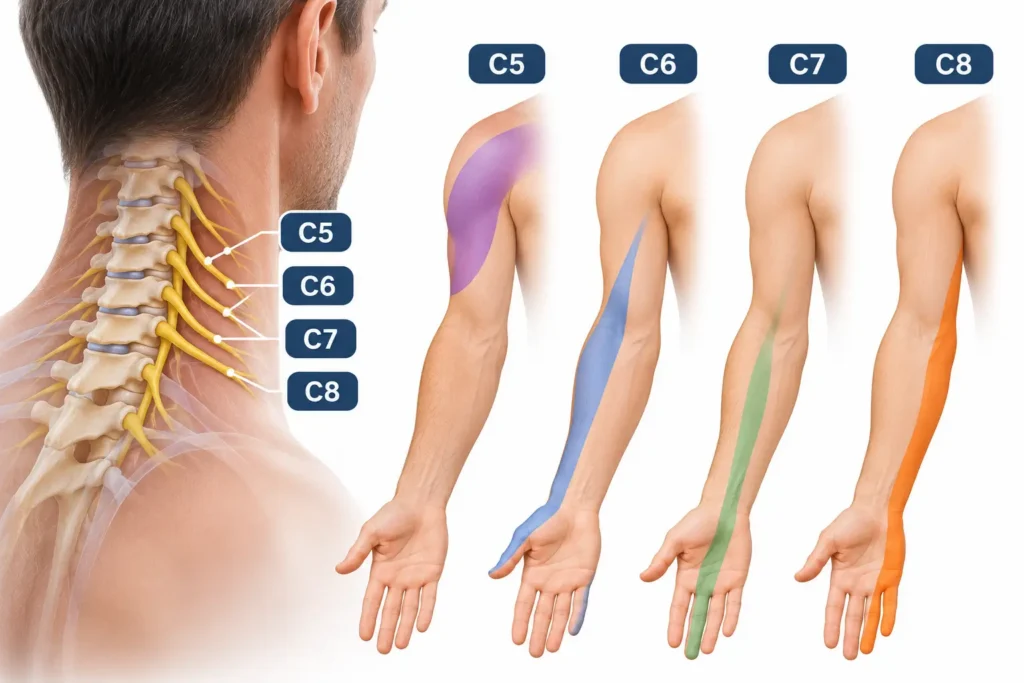
The symptoms depend on which nerve root is involved, but the pattern is similar wherever it happens:
With a neck root, many people find that resting the hand on top of the head eases arm pain, because it takes tension off the nerve. With a lower back root, sitting for a long time is often the worst position.
Thoracic radiculopathy is easy to mistake for a heart, lung or abdominal problem, so it should always be checked properly. The pain of shingles can follow the same band; see postherpetic neuralgia.

Go to an emergency department or call 911 if nerve pain comes with:
Anything that crowds or inflames the nerve root where it exits the spine can cause radiculopathy. The most common causes:
Disc material presses on the root and releases chemicals that inflame it. The leading cause in younger adults.
Bone spurs and thickened tissue narrow the exit openings. More common after 50.
Worn joints at the back of the spine form spurs or cysts beside the nerve.
Trauma such as a car accident or fall can damage a disc or joint. Neck injuries like whiplash can lead to cervical radiculopathy.
Arthritis and degenerative disc disease are the background to many cases. Less often, diabetes, infection or a tumor is responsible.
Where the pain travels, what positions affect it, and any numbness, weakness or changes in coordination.
Strength, reflexes and sensation in each nerve's territory. Specific tests, such as the straight leg raise or gently tilting the head toward the painful side, reproduce nerve root pain.
An MRI shows discs, bone spurs and nerves. Nerve conduction studies and EMG show whether a nerve is working normally and help separate a root problem from carpal tunnel or ulnar nerve compression.

Radiculopathy very rarely needs surgery. The aim is to calm the inflamed nerve and give it time to recover.
Activity changes, posture adjustments and pain relief
Physical therapy and a short course of medication
Image-guided epidural steroid injection
Surgical referral if weakness worsens or pain persists
Physical therapy works on posture, strength and gentle nerve mobility. For neck radiculopathy, that often includes exercises for the deep neck and shoulder blade muscles; for the lower back, core and hip strength.
Medication such as anti-inflammatories or a short course of nerve pain medicine can help some people through the worst weeks.

An epidural steroid injection places anti-inflammatory medicine close to the affected root under X-ray guidance. It can reduce pain enough to make therapy possible. Relief lasts weeks to months and varies between people. Read more about image-guided injections.
Surgery is considered for progressive weakness, spinal cord compression, or severe pain that has not improved with good non-surgical care. ReclaimAbility does not perform surgery and refers to spine surgeons when needed.
A ReclaimAbility physician can examine you, review any scans you already have and explain your choices in plain terms.
Most people improve over six to twelve weeks. Pain usually eases first; numbness and weakness can take longer, sometimes months, because nerves recover slowly. Symptoms that last beyond three months, or that keep returning, are worth a specialist review to look for a cause that needs a different approach.
Keeping up exercises, taking breaks from long periods of sitting or looking down at screens, and lifting with good technique all lower the chance of a repeat episode.
Book an evaluation if:
At your first visit a physician takes a full history, examines you, reviews any imaging and talks through a plan with you. Here is what to expect at your first appointment. Some insurance plans require a referral, so it is worth checking with yours before you book.
Four South Jersey offices. Most major insurance plans, auto accident (PIP) and workers’ compensation accepted.
Our physicians diagnose and treat cervical, thoracic and lumbar radiculopathy at all four offices. See our approach to neck pain treatment and low back pain treatment in South Jersey.
15000 Midlantic Drive, Suite 102
807 N Haddon Avenue, Suite 1
1801 New Road
329 Greentree Road, Sewell
Open Monday to Friday, 8:00 a.m. to 4:30 p.m. We accept most major insurance plans, plus auto accident (PIP) and workers’ compensation. See accepted insurance or meet the full team.
Yes, in the spine. Radiculopathy specifically means a pinched or irritated nerve root where it leaves the spine. A nerve can also be pinched further along its path, such as at the elbow or wrist, which is a different condition.
Most sciatica is lumbar radiculopathy: an irritated nerve root in the lower back causing pain down the leg.
Often it does. Many people improve over six to twelve weeks as inflammation settles, especially when they stay active and follow a therapy program.
Usually not. Numbness often lags behind the pain and can take months to fade. Lasting numbness is more likely when a nerve has been compressed severely or for a long time, which is why worsening symptoms should be checked.
Not always at first. An MRI is useful if symptoms last beyond about six weeks, if there is weakness or warning signs, or before an injection or surgery.
Sources
This page is for general education and is not a substitute for a medical evaluation. If you have new or worsening symptoms, talk with a qualified clinician.
A ReclaimAbility pain specialist can look for the source of your pain and talk you through your options. New-patient appointments are available at all four South Jersey offices. Learn more about neck pain treatment in South Jersey.