
Pain that starts deep in one buttock and travels down the back of the leg almost always gets called sciatica. Patients use the word, search engines use it, and plenty of clinicians use it as shorthand. Most of the time the label is right. Sometimes it isn’t, and the treatment that should have worked keeps not working.
The usual stand-in is piriformis syndrome. Both conditions irritate the same nerve and can feel almost identical, but one starts in the spine and the other starts in a small muscle in the hip. That distinction decides which treatment makes sense, so our physicians take time to sort it out before recommending anything. If your pain began in the lower back, our page on low back pain and sciatica treatment covers the wider picture. This article focuses on telling these two apart.
Same nerve, two different places for it to get pinched
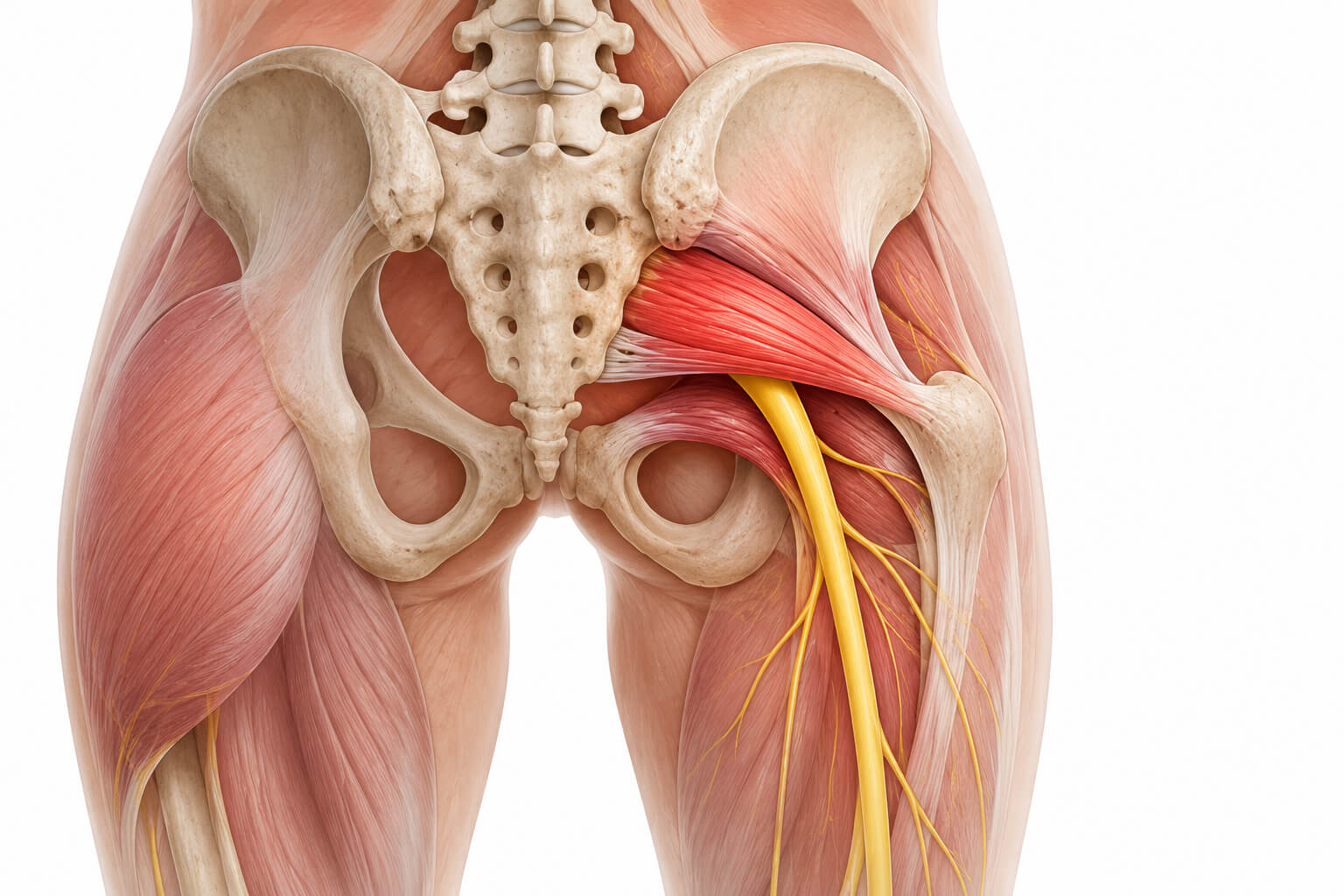
The sciatic nerve is built from several nerve roots that leave the lower spine and sacrum. They merge inside the pelvis, exit through an opening at the back of the hip, and pass directly beneath the piriformis, a flat muscle that runs from the sacrum to the top of the thigh bone. From there the nerve continues down the back of the leg.
True sciatica, which doctors call lumbar radiculopathy, means one of those nerve roots is being irritated at the spine itself. The most common culprit is a herniated disc. In older patients, narrowing of the spinal canal from spinal stenosis is a frequent cause.
Piriformis syndrome means the nerve is being irritated further down, where it passes the muscle. The muscle may be in spasm, tight, or swollen after a fall onto the buttock. In some people the nerve actually runs through the muscle rather than beneath it, which leaves less room for error.
One honest caveat. Piriformis syndrome is far less common than spine-related sciatica, and it remains a debated diagnosis. There is no single test that proves it, so it is usually confirmed by ruling other causes out. Anyone who tells you otherwise with complete confidence is overselling.
Side by side: how they usually behave
| Feature | Sciatica from the spine | Piriformis syndrome |
|---|---|---|
| Where the pain starts | Low back, then buttock and leg | Deep in one buttock |
| How far down it goes | Often below the knee, sometimes into the foot or toes | Usually buttock and back of thigh, less often below the knee |
| Coughing or sneezing | Often sends a jolt down the leg | Usually no effect |
| Prolonged sitting | Can worsen it | Often the main trigger, especially on hard seats |
| Numbness or weakness | Can follow a specific strip of the leg or foot | Less common, and usually vaguer |
| Straight-leg raise test | Frequently reproduces leg pain | Often negative |
| Lumbar MRI | May show a disc or narrowing at the matching level | Usually normal for the symptoms |
Read every row with the word “usually” in mind. A herniated disc can hurt more when sitting, too. And the two can exist side by side, which is one reason self-diagnosis from a chart tends to go sideways.
Clues that point back to your spine
Pain that runs past the knee and follows a fairly consistent line toward the foot suggests a nerve root problem. So does pain that spikes when you cough, sneeze, or strain, since those actions briefly raise pressure inside the spinal canal.
Neurological changes carry even more weight. Numbness in particular toes, a weaker push-off when walking, trouble standing on your heels or toes, or a reflex that has gone quiet on one side all point to a specific root in the lower spine. In the exam room, lifting the straightened leg while you lie on your back often reproduces the leg pain when a disc is involved.
Clues that point to the piriformis
The classic piriformis story is a deep ache in one buttock that builds the longer you sit, particularly on a hard chair, during a long drive, or with a wallet in your back pocket. Getting up from a seat, climbing stairs, or getting out of the car can bring it on.
Pressing firmly into the middle of the buttock usually finds a tender spot that recreates the familiar pain. Bringing the bent knee across the body and rotating the hip inward, a maneuver clinicians call the FAIR test, tends to provoke it as well. Meanwhile the neurological exam is often normal. There is frequently a starting point patients remember, such as a fall onto the backside, a jump in running mileage, or a long weekend of yard work.
How a pain specialist sorts it out
The workup starts with your history, which does more of the diagnostic work than most people expect. When did it begin, what sets it off, and how far down the leg does it go? The physical exam then adds strength, reflex, and sensation testing along with the provocative tests above. Your physician will also check the hip and the sacroiliac joint, since both can produce buttock and leg pain that mimics either condition.
Imaging comes in when it can change the plan. National guidance discourages an MRI in the first several weeks of back and leg pain unless there are warning signs, because scans often show disc bulges in people who have no pain at all. An MRI becomes useful when symptoms persist, when there is weakness or numbness, or when an injection is being considered.
When the picture is still unclear, a diagnostic injection can settle it. Under ultrasound or X-ray guidance, a small amount of numbing medicine is placed in the piriformis. If the usual pain disappears for several hours, the muscle is very likely the source. If nothing changes, attention shifts back to the spine.
Why getting it right changes your treatment
Most disc-related sciatica improves over several weeks with staying active, physical therapy, and short-term medication. When leg pain persists or limits daily life, an epidural steroid injection places anti-inflammatory medicine close to the irritated nerve root. Surgery is generally reserved for progressive weakness or pain that has not responded to good nonsurgical care.
Piriformis syndrome calls for a different plan. Physical therapy focuses on stretching the deep hip rotators, strengthening the glutes, and changing how you sit. If that stalls, an image-guided injection into the muscle can calm it down. Surgery is rare.
Mixing them up has a real cost. An epidural will do little for a muscle problem, and an aggressive stretching routine can aggravate an irritated disc. Weeks of the wrong treatment are weeks of pain you probably didn’t need to have.
When to get evaluated, and when not to wait
Most new back and leg pain settles on its own, and our guide on how long back pain should last before you see a specialist walks through the usual timeline. It makes sense to book an evaluation if leg pain lasts beyond four to six weeks, keeps coming back, or is interfering with sleep or work.
Some symptoms should not wait for an appointment. Go to an emergency department if you notice loss of bladder or bowel control, numbness in the groin or inner thighs, leg weakness that is getting worse quickly, or back pain with fever. The same applies after a significant fall or car accident.
If you have been living with buttock and leg pain and aren’t sure where it is coming from, our physicians can help you find out. ReclaimAbility Pain Services sees patients at offices in Mount Laurel, Haddonfield, Washington Township, and Linwood. Request an appointment or call 855-727-2465.
This article is for general education and is not a substitute for a medical evaluation. If you have new or worsening symptoms, talk with a qualified clinician.