
Most people who eventually get diagnosed with rheumatoid arthritis remember the same small moment: a morning when their hands just didn’t work right. Rings that wouldn’t slide over a knuckle. A coffee mug that felt heavier than it should. Fingers that needed a good half hour — sometimes longer — before they’d cooperate.
And most of those people did what you’re probably doing now. They waited, assumed it was overuse or age or sleeping on their arm funny, and searched their symptoms at 2 a.m.
Here’s why that search matters more than you might think. Rheumatoid arthritis is one of the few joint conditions where when you start treatment changes the outcome dramatically. Rheumatologists talk about a “window of opportunity” — roughly the first months after symptoms appear — when treatment can slow or even prevent the joint damage that becomes permanent later. The hands are usually where RA announces itself first, which makes them the best early warning system you have.
So let’s walk through what early RA actually feels like in the hands, how to tell it apart from garden-variety aches, and when it’s time to stop wondering and get evaluated.
What Early RA Feels Like in the Hands
RA is an autoimmune disease. Your immune system mistakenly attacks the lining of your joints — the synovium — and that lining responds by becoming inflamed, thickened, and swollen. In the hands, that process has a fairly recognizable signature.
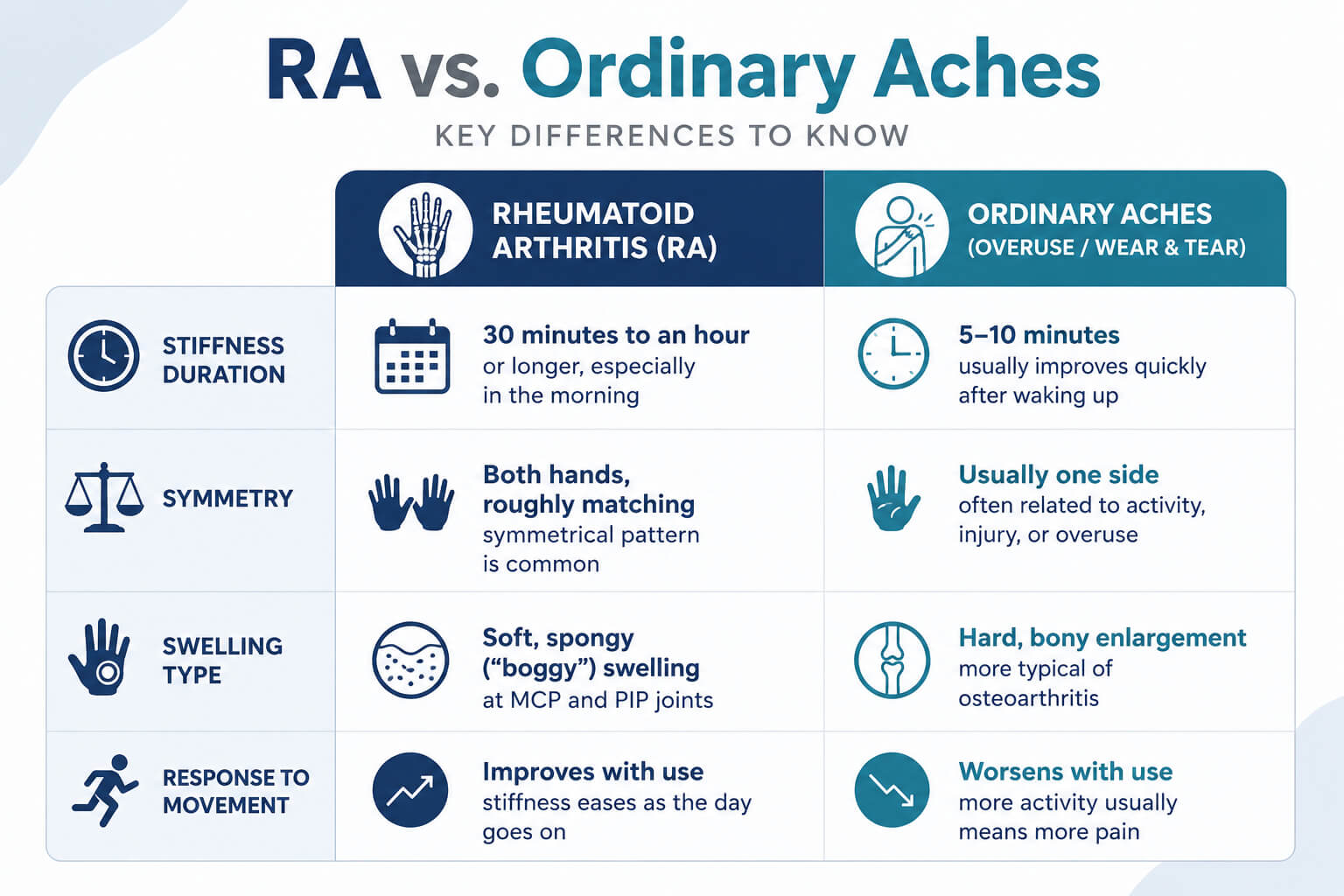
Morning stiffness that overstays its welcome. Almost everyone’s hands feel a little stiff on waking. The difference with RA is duration. Ordinary stiffness works itself out in five or ten minutes; RA stiffness typically lasts 30 minutes to an hour, sometimes stretching well beyond that. Patients describe it as their hands feeling “wooden” or like they’re wearing tight gloves. It gradually eases as you move through the morning — which, counterintuitively, is a clue. Inflammatory stiffness improves with movement. Wear-and-tear stiffness tends to get worse the more you use the joint.
Swelling you can feel more than see. Early RA swelling is often subtle. It shows up at the knuckles at the base of the fingers (the MCP joints) and the middle finger joints (the PIPs), and it has a soft, spongy, almost boggy quality when you press on it — quite different from the hard, bony enlargement of osteoarthritis. A practical tell many patients notice before anything else: rings suddenly don’t fit, or fit differently at different times of day.
Both hands, roughly matching. This is one of the strongest signals. RA is usually symmetrical. If your right index and middle knuckles ache, the left ones often do too — maybe not identically, but in a mirrored pattern. An injury or overuse problem almost never does this. If one hand hurts after a weekend of yard work, that’s probably strain. If both hands ache in the same joints for no reason you can name, pay attention.
Which joints — and which ones are spared. RA has favorite targets: the large knuckles, the middle finger joints, and the wrists. What it usually skips early on are the joints closest to your fingertips (the DIP joints). Those end joints are classic osteoarthritis territory. It’s not an absolute rule, but where the pain lives tells an experienced clinician a lot.
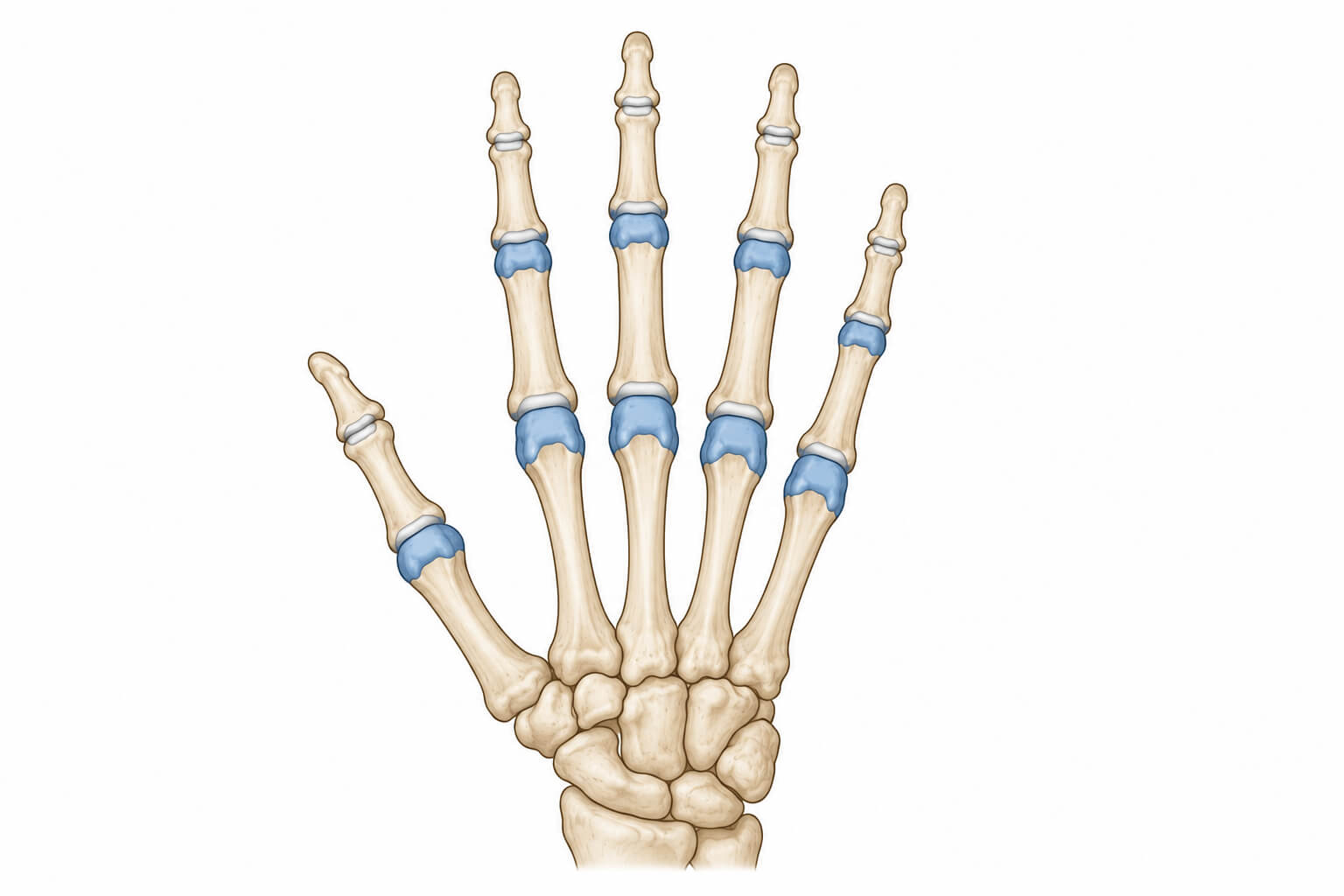
A weaker, clumsier grip. Jar lids, doorknobs, buttoning a shirt, opening a car door. Inflammation in the small joints and surrounding tendons saps grip strength surprisingly fast, and some people feel this before they’d describe themselves as being in “pain” at all.
Tenderness with a gentle squeeze. Clinicians use something called the squeeze test — gently compressing across the row of knuckles. In early RA that’s often uncomfortable even when the joints look normal. If shaking hands has started to genuinely hurt, that’s worth mentioning to a doctor, not toughing out.
And the symptom nobody connects to their hands: fatigue. RA is a whole-body disease. Long before joint damage shows on an X-ray, many patients feel drained in a way sleep doesn’t fix — sometimes with low-grade fevers or a flu-ish, run-down feeling. In our practice, it’s common to hear someone say the exhaustion bothered them more than the joint pain in those first months. If unusual fatigue is riding along with hand stiffness, treat that combination as meaningful.
RA vs. Ordinary Aches: Key Differences
Plenty of things make hands hurt — typing, texting, gardening, osteoarthritis, carpal tunnel. Most of them aren’t RA. A few contrasts do a lot of sorting work:
The pattern of the pain. Overuse pain follows activity and settles with rest. RA pain shows up unprovoked, often worst in the early morning or after sitting still, and improves with gentle movement.
How the stiffness behaves. Under 15 minutes of morning stiffness points away from inflammation. Thirty minutes or more, day after day, points toward it.
The character of the swelling. Soft, warm, squishy swelling suggests inflamed synovium. Hard, knobby bumps at the fingertip joints suggest osteoarthritis. (We cover this comparison in depth in our guide to RA vs. osteoarthritis.)
Symmetry. One sore thumb after a week of heavy phone use is an overuse story. Matching sore knuckles on both hands is an inflammation story.
What comes with it. Overuse doesn’t cause fatigue, low-grade fever, or a general sense of being unwell. Autoimmune inflammation can.
One honest caveat: none of these rules is airtight. There’s a version of RA that starts in a single joint, and a form called seronegative RA where standard blood tests come back normal despite real disease. That’s exactly why persistent symptoms deserve a professional evaluation rather than a self-diagnosis — in either direction. We’ve met patients who were sure they had RA and didn’t, and patients who talked themselves out of symptoms for a year that turned out to be textbook.
When to See a Specialist (and What Diagnosis Involves)
Our practical rule of thumb: if hand pain, stiffness, or swelling in both hands has lasted six weeks or more, get evaluated. Six weeks is roughly the line where “probably a strain” stops being the safest assumption. And if you have significant swelling in multiple joints, don’t wait even that long.
It’s worth being seen sooner rather than later if any of these apply:
- Morning stiffness regularly lasting past the half-hour mark
- Soft swelling at the knuckles or middle finger joints, especially on both sides
- A family history of RA or other autoimmune disease
- Joint symptoms traveling with fatigue, low-grade fevers, or unexplained weight loss
- Grip strength that’s noticeably slipping
Waiting is the one move that has no upside. If it isn’t RA, an evaluation buys you peace of mind and usually an answer for what it actually is. If it is RA, you’ve just protected your future joints — modern treatment started early can put many patients into remission, something that was nearly unthinkable a generation ago.
As for what the workup looks like: it’s less dramatic than most people expect. A clinician will take a careful history (when symptoms started, how long stiffness lasts, what makes things better or worse — it helps to jot this down beforehand) and examine each joint for swelling, warmth, and tenderness. Blood tests typically include rheumatoid factor and anti-CCP antibodies, along with inflammation markers like ESR and CRP. Anti-CCP deserves special mention: it’s highly specific for RA and can turn positive years before symptoms fully develop. Imaging rounds things out — X-rays for a baseline, and increasingly musculoskeletal ultrasound, which can spot active joint-lining inflammation long before damage would ever appear on an X-ray.
No single test makes the diagnosis. It’s the combination — your story, the exam, the labs, the imaging — which is also why a normal blood test alone doesn’t rule RA out.
The bottom line: your hands are usually the first place RA speaks up, and it tends to speak quietly at first. Stiffness that lingers past half an hour, soft swelling at the knuckles, symptoms mirrored across both hands, and fatigue that doesn’t add up — that cluster deserves a professional look, not another few months of waiting to see if it passes.
If your hands have been trying to tell you something, schedule an evaluation with our team. Sorting out joint pain early is one of the highest-value things you can do for your long-term health — and if the answer turns out to be reassuring, that’s a good day too.
This article is for educational purposes and isn’t a substitute for professional medical advice, diagnosis, or treatment. Always consult a qualified healthcare provider about your specific symptoms. If you experience sudden severe joint pain, significant swelling with fever, or signs of infection, seek medical care promptly.