
“It’s just arthritis.” Patients say this to us all the time, usually with a shrug, as if arthritis were one disease with one cause and one future. It isn’t. The word covers more than a hundred conditions, and the two most common ones, rheumatoid arthritis and osteoarthritis, have almost nothing in common beyond sore joints and a shared last name.
The mix-up isn’t harmless, either. We’ve met people who spent a year treating an autoimmune disease with rest and glucosamine, and others convinced they had a progressive immune condition when the real problem was wear in one overworked knee. Getting the label right is the first real decision in treating joint pain, because the medications, the urgency, and the long-term outlook all depend on it.
Two Different Diseases, Similar Pain
Osteoarthritis (OA) is a problem of the cartilage. The smooth tissue cushioning your bones gradually thins from years of load, an old injury, extra weight, or plain genetics. As the cushion wears down, the joint stiffens and the body builds small bony spurs. It’s a mechanical process, and it behaves mechanically: the more you load the joint, the more it complains.
Rheumatoid arthritis (RA) is a problem of the immune system. The joint starts out healthy, but immune cells attack its lining, and the inflamed lining releases enzymes that erode cartilage and bone from the inside. RA isn’t confined to joints; the same inflammation can affect the eyes, lungs, and heart, and it causes body-wide symptoms (deep fatigue, low-grade fevers) that OA never does.
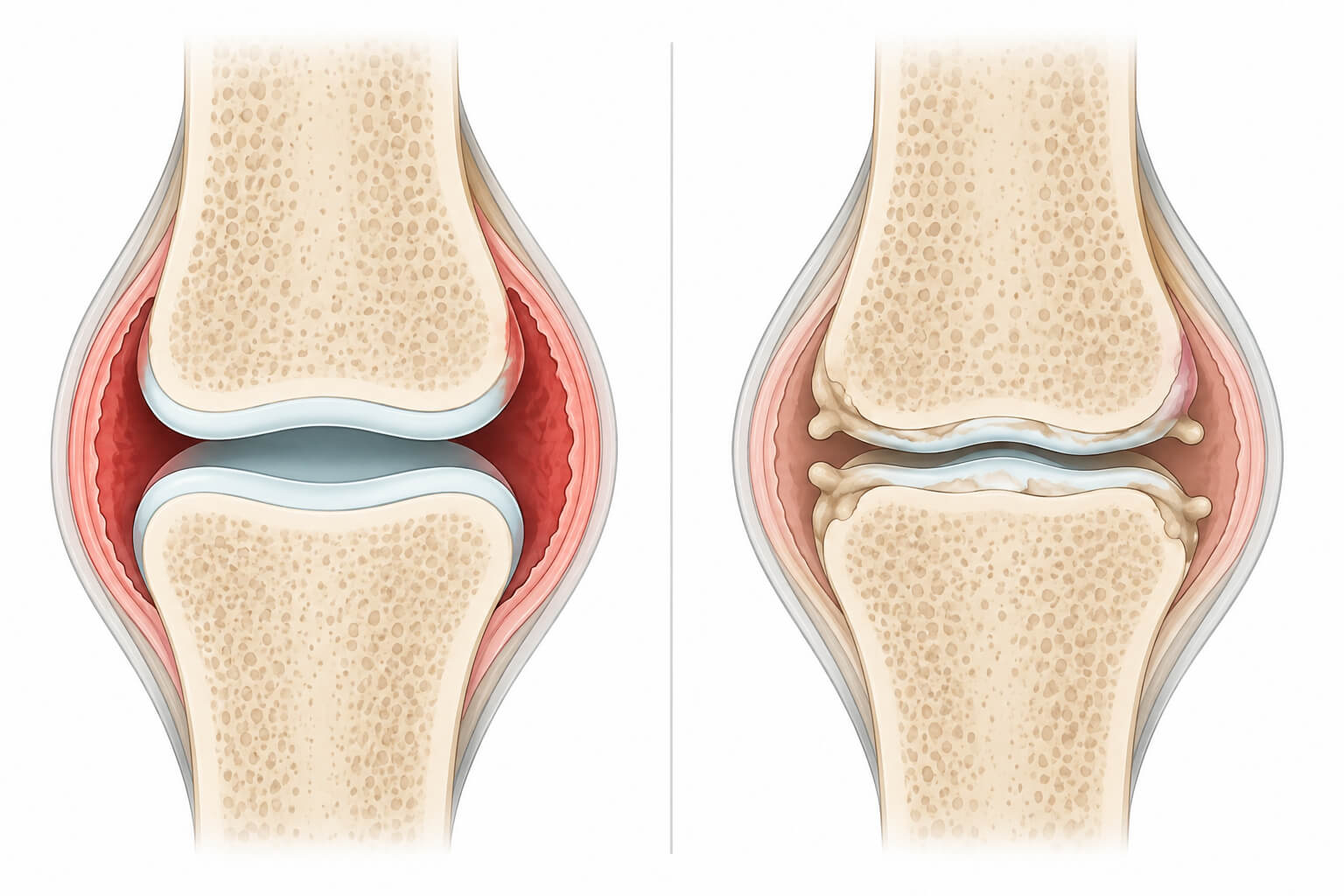
A shorthand we give patients: OA is a joint that’s wearing out. RA is a joint that’s under attack.
The mechanism also explains who gets each one. OA accumulates, so it’s uncommon before midlife. RA arrives, sometimes over a few months, often at 30 or 40, in someone whose joints were fine the year before.
Symptom Comparison Chart: Onset, Stiffness, Symmetry
| What to look at | Rheumatoid Arthritis | Osteoarthritis |
|---|---|---|
| How it starts | Over weeks to months, sometimes with fatigue or feeling unwell | Over years, often in a joint with a history of injury or heavy use |
| Morning stiffness | An hour or more before joints loosen | Usually gone within 15–30 minutes |
| Activity | Movement helps; rest makes joints seize up | Activity aggravates; rest relieves |
| Symmetry | Mirrored: same joints on both sides | Often one-sided: the injured knee, the dominant thumb |
| Favorite joints | Small joints first: knuckles, wrists, balls of the feet | Knees, hips, spine, fingertip joints, thumb base |
| Swelling feels like | Soft, warm, spongy | Hard and bony (spurs and nodes) |
| Whole-body symptoms | Yes: fatigue, low-grade fever, appetite loss | No; symptoms stay local to the joint |
Three of these carry the most weight. First, the stiffness clock: a patient who can’t make a fist until mid-morning has us thinking inflammation, while a knee that’s creaky for a few steps and then fine points to wear. Second, the activity response, which runs in opposite directions: an RA joint loosens with gentle motion, while an OA knee that felt fine at breakfast aches after a long walk. Pay attention to this for a week; it tells you a lot. Third, location, which is nearly a fingerprint: fingertip joints and the thumb base point toward OA, while the row of large knuckles and both wrists point toward RA. (If your symptoms are concentrated in your hands, our guide to the early signs of rheumatoid arthritis in the hands covers that pattern joint by joint.)
One honest caveat: real patients don’t always read the textbook. The two diseases can coexist, and a 62-year-old can have RA in her hands and OA in her knee at the same time. Use the chart to organize your observations, not to close the case.
Why the Distinction Changes Your Treatment
RA treatment targets the immune system, and the calendar matters. Disease-modifying drugs and biologics don’t just dull pain; they shut down the attack itself. Started early, they can halt joint destruction before it shows on an X-ray, and remission is now a realistic goal. Started late, they still help, but the erosion that already happened doesn’t grow back. RA is one of the few forms of joint pain where waiting genuinely changes your future.
OA management is a different playbook: protect and support the joint. Strengthen the muscles that unload it, adjust activity and weight where relevant, and quiet stubborn pain with targeted options such as joint injections or radiofrequency ablation, which calm pain signals without surgery. Done well, OA care keeps people active for decades.
Mixing them up costs you either way. Treat RA like OA (ice it, rest it, wait it out) and you burn through the window when immune-targeting treatment works best. Treat OA like RA and you take immune-suppressing medication you never needed. A proper workup settles it: a joint-by-joint exam, blood tests (rheumatoid factor, anti-CCP, inflammation markers), and imaging, since the two diseases even damage joints in different patterns on an X-ray.
Both are treatable. Neither is “just arthritis.” If you’re not sure which story is yours, that’s exactly what an evaluation is for. Book an appointment with our team and we’ll sort it out, usually in a single visit.
This article is for educational purposes and isn’t a substitute for professional medical advice, diagnosis, or treatment. Always consult a qualified healthcare provider about your specific symptoms. Seek prompt medical care for sudden severe joint pain, a hot swollen joint with fever, or an injury with inability to bear weight.