
Here is something most articles about back pain leave out. For the majority of people with a new episode of low back pain, no one ever pins it to one exact structure, and most of them get better anyway. Muscles, ligaments, discs, and small joints all sit close together and share nerve supply, so the pain itself often doesn’t reveal its source.
That changes when pain lasts, keeps coming back, or starts traveling. Then the cause matters, because each one responds to different treatment. Below are the causes our physicians see most often, along with the clues that tend to point toward each. For a broader look at how we evaluate and treat the lower back, see our page on low back pain and sciatica treatment.
Muscle strain and ligament sprain
This is the most common cause of sudden low back pain by a wide margin. Lifting something awkwardly, twisting while carrying a load, or a weekend of unfamiliar work in the yard can overstretch the muscles and ligaments that support the spine.
The pain is usually across the lower back, sometimes worse on one side, and it often comes with spasm that makes standing up straight difficult. It doesn’t travel below the knee. However dramatic the first day feels, most strains improve within a couple of weeks with gentle movement. Bed rest slows recovery.
Disc problems: herniation and degeneration
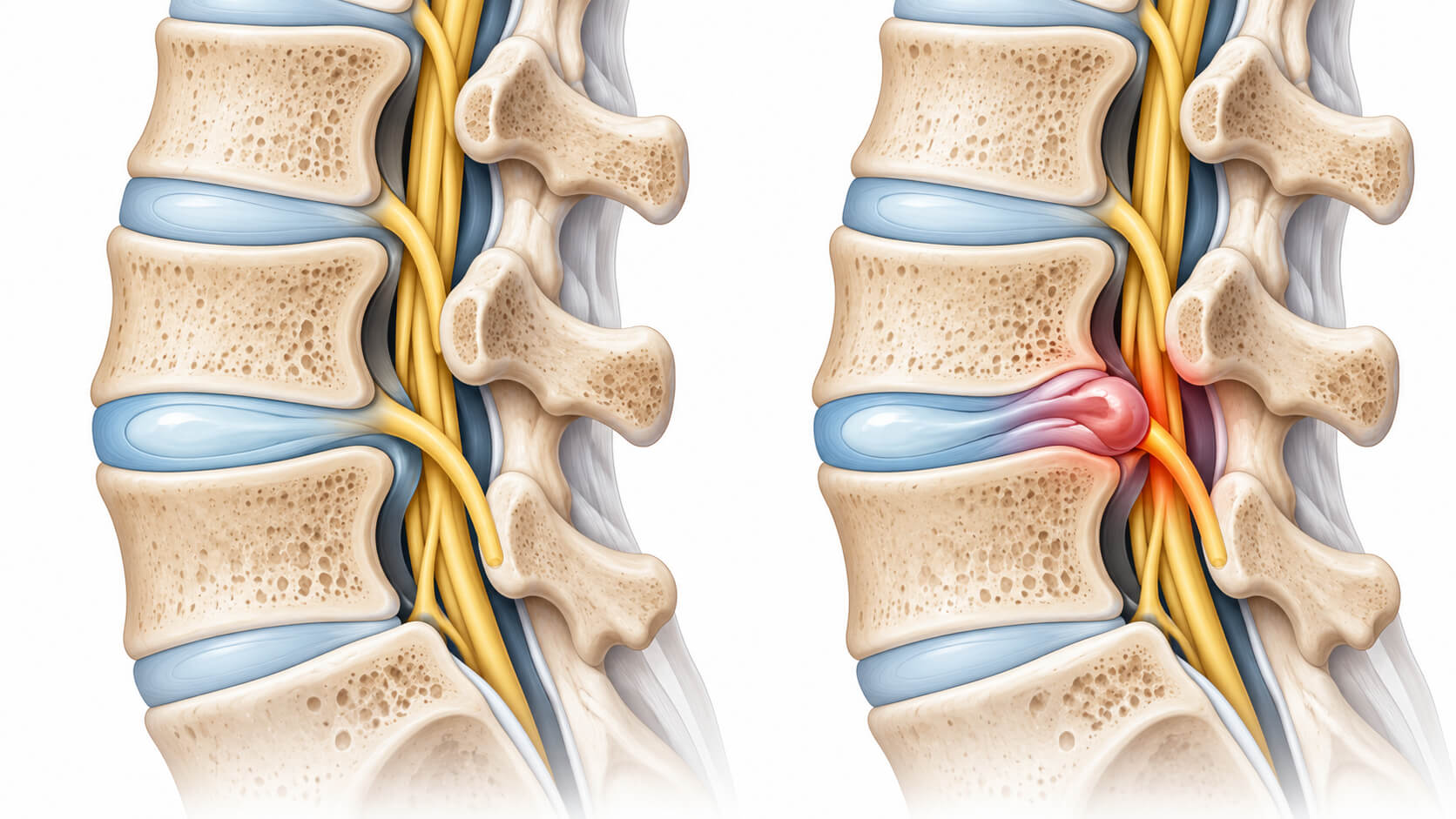
The discs between the vertebrae are tough rings of fibrous tissue around a softer, gel-like center. With age they lose water and height, which is called degenerative disc disease. Despite the name, it’s a normal part of aging, and plenty of people with worn discs on an MRI have no pain at all.
A disc herniation is different. Part of the softer center pushes through the outer ring and can press on a nearby nerve root. The giveaway is leg pain, often worse than the back pain, running below the knee and sometimes into the foot. Sitting, bending forward, coughing, or sneezing typically make it worse. Herniations are most common between the ages of about 30 and 50, and many shrink on their own over weeks to months. If you’re not sure whether leg pain is coming from a disc or a hip muscle, our article on sciatica vs. piriformis syndrome walks through the difference.
Facet joint arthritis
Each vertebra connects to the next through a pair of small joints at the back of the spine, called facet joints. Like knees and hips, they can develop arthritis. The pain tends to be an ache across the low back or to one side, stiff first thing in the morning and worse when you lean backward, twist, or stand for a long time. It may spread into the buttock or upper thigh but rarely past the knee.
Facet pain is hard to confirm with imaging alone, since arthritic changes are common on scans. A small diagnostic nerve block that temporarily numbs the joint is often how physicians find out whether it’s truly the source. You can read more on our spondylosis and facet syndrome page.
Spinal stenosis
Spinal stenosis means the spaces nerves travel through have narrowed, usually from a combination of disc wear, thickened ligaments, and arthritis. It’s mainly a condition of people over 60.
It has one of the most recognizable patterns in back pain. Standing and walking bring on heaviness, aching, or tingling in the buttocks and legs, and sitting down or leaning forward relieves it within minutes. Many patients can walk much farther leaning on a grocery cart than on an open sidewalk, because leaning forward opens the narrowed space slightly.
Sacroiliac joint problems
The sacroiliac joints connect the base of the spine to the pelvis, one on each side. When they’re irritated, the pain sits low, just below the belt line and slightly to one side, and people often point to it with one finger. Climbing stairs, getting out of a car, or rolling over in bed can set it off. It’s easy to mistake for a disc problem, and it accounts for a meaningful share of low back pain that doesn’t improve as expected.
Muscle knots and myofascial pain
Sometimes the problem is in the muscles themselves, even after an injury has healed. Tight, tender bands within the muscle, often called trigger points, can produce a deep, nagging ache and refer pain to nearby areas. This kind of myofascial pain often travels alongside other back problems and can outlast them.
A quick comparison
| Cause | Typical age | The main clue |
|---|---|---|
| Muscle strain or sprain | Any age | Sudden onset after activity, no pain below the knee |
| Disc herniation | About 30 to 50 | Leg pain below the knee, worse sitting or coughing |
| Facet joint arthritis | Over 50 | Morning stiffness, worse leaning back or twisting |
| Spinal stenosis | Over 60 | Legs give out walking, better sitting or leaning forward |
| Sacroiliac joint | Any adult | One-sided pain just below the belt line |
| Myofascial pain | Any age | Tender knots in the muscle, deep persistent ache |
Patterns overlap, and more than one cause can exist at the same time. Treat the table as a starting point for a conversation with your physician, not a diagnosis.
Less common causes worth knowing
A few causes are rarer but important not to miss. Compression fractures of the vertebrae can happen with surprisingly little force in people with osteoporosis. Spondylolisthesis, where one vertebra slips forward on the one below, can narrow the space for nerves. And some back pain doesn’t come from the spine at all. Kidney stones, kidney infections, and, in older adults, problems with the abdominal aorta can all be felt in the back.
Get checked promptly, and go to an emergency department for the more severe items here, if back pain comes with fever, unexplained weight loss, a history of cancer, pain that is worse at night and not eased by rest, loss of bladder or bowel control, numbness in the groin, or leg weakness that is getting worse.
Everyday factors that raise the risk
Long stretches of sitting, low fitness, extra weight, smoking, and physically demanding work all make back pain more likely or slower to settle. Poor sleep and stress don’t cause it, but they make it louder and harder to shake. These are also where small, steady changes pay off most.
When the cause needs a closer look
Most back pain improves within a few weeks, and our guide on how long back pain should last before you see a specialist lays out a reasonable timeline. If your pain has lasted beyond six weeks, keeps returning, or is spreading into a leg, it’s worth having it properly evaluated. Not sure what that involves? Here’s what to expect at your first appointment.
ReclaimAbility Pain Services treats back pain at offices in Mount Laurel, Haddonfield, Washington Township, and Linwood. Request an appointment or call 855-727-2465.
This article is for general education and is not a substitute for a medical evaluation. If you have new or worsening symptoms, talk with a qualified clinician.